
Arriva is a leader in European passenger transport, in the UK it’s responsible for moving millions of passengers safely, efficiently, and sustainably every year. Like many, Arriva faces increasing pressure to reduce operational costs, improve workshop efficiency, and deliver measurable sustainability improvements.
Parts cleaning plays an essential role in vehicle maintenance and it’s an area in which sustainability efforts can have a significant impact.
The Challenge: Energy Efficient Parts Cleaning at Speed
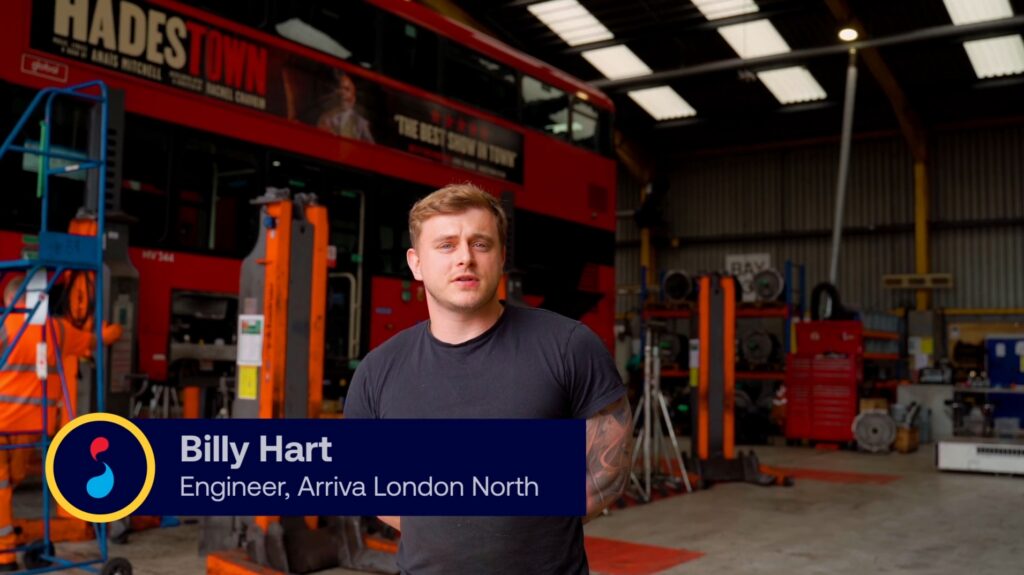
Machine-based parts cleaning typically operates at 65°C, it’s effective but energy‑intensive. For large depots running machines daily, that energy use adds up. “Previously our washers were running at about 65-70°C, and we would use them between the hours of 5:00am to 3:00pm,” says Billy Hart, Engineer at Arriva’s Grey’s Garage in North London, where they service a fleet of 70 buses. “Some days it’d be half the time; some days it’d be a constant cycle,”
Arriva’s parts cleaning process produced a lot of steam and required long cooling times before parts could be handled and refitted, slowing workflow and creating discomfort for technicians.
The company needed a more energy‑efficient, safer, and faster cleaning process without compromising cleaning performance.
The Solution: Kleen35® Low‑Temperature Parts Cleaning
Safetykleen introduced Arriva to Kleen35® , our newest innovation in energy‑efficient industrial cleaning, delivering high‑performance at low temperatures. Billy and his team could now reduce their parts washing from 70°C to 35°C, lowering cost, energy and emissions while improving both safety and productivity.
Arriva trialed Kleen35 ® across daily cleaning cycles and high‑contamination parts together with their M115 Aquakleen Automatic parts washer. “Our parts are very contaminated. Parts that I typically clean are the ramps. They sit underneath the vehicle and get stuck in all the grime and the road grit,” Billy explains.
Results
Energy Savings
Arriva’s team dialed their 30-minute cleaning cycles down from 70°C to 35°C, seeing a 48% energy reduction, falling from 56kWh over a 24-hr period to 29kWh. “That’s a definite improvement! Clearly better,” says Billy.
Carbon Footprint Reduction
Saving energy also means reducing carbon emissions, which is high on the agenda of manufacturers and engineers across all industries. “We aim all the time to lessen our footprint and we’re always watching our waste management here. What you guys are changing with the machines is helping our sustainability project, which is amazing. It’s helping us be greener and working towards the future,” says Grace Doucett, Engineering Manager at Arriva’s Grey’s Garage.
Safetykleen’s independent laboratory tests show that the average customer can lower their annual CO₂ emissions by 367kg when moving to Kleen35®. That’s equal to saving 50 trees per customer, per year.
Improved Productivity
Lower temperature cleaning means less time is needed for your parts washer machine to heat up and no time waiting around for the clean parts to cool. Safetykleen’s laboratory tests show machine heat up times are on average 55% faster when washing at 35°C with Kleen35®. This improvement is making a difference at Arriva. “It’s very important with the work that we do. It’s very fast‑paced, and we turn out a lot of items. Keeping that same quality and that same timeframe allows us to keep a nice schedule of work,” explains Billy.
Workshop Safety & Comfort
Switching to Kleen35® means you can significantly reduce the amount of steam generated from high temperature washing. Our laboratory tests show that there is 5x less steam when washing at 35°C versus 65°C. This improves safety, comfort and visibility for operators who would otherwise need to take precautions.
Billy explains: “When you first open the machine, previously you’d get a face full of steam. It’s not nice if you forget, or you’re moving too quickly. Now there’s hardly any steam. I can get in, get my parts out and crack on”.


